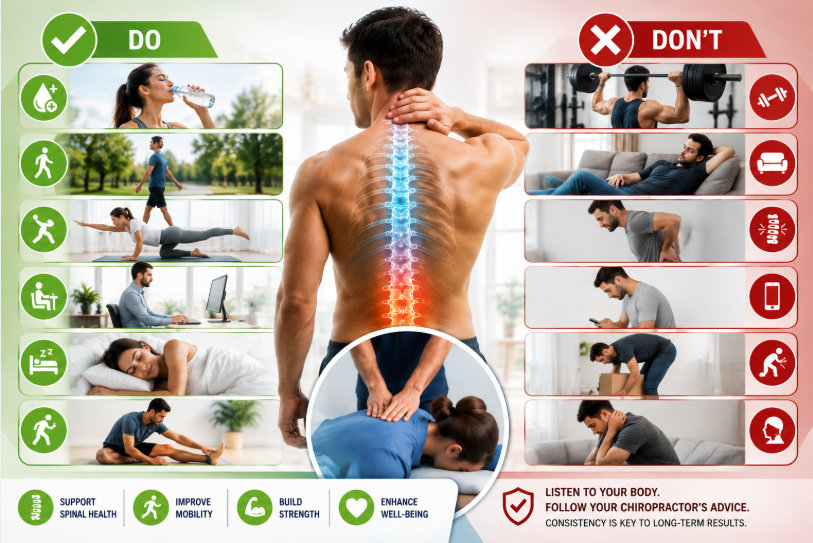
After a chiropractic adjustment, what you do between appointments can be an important part of your overall care. Chiropractic treatment may help address certain musculoskeletal problems, but your everyday habits—including movement, exercise, posture, sleep, and activity level—can also affect how you feel.
Whether you are receiving chiropractic care for neck pain, back pain, stiffness, an injury, or another musculoskeletal concern, following your chiropractor’s recommendations can help you get the most from your treatment plan.
Here are some important Do’s and Don’ts after a chiropractic adjustment.
DO: Stay Hydrated
Drinking enough water is an important part of maintaining your overall health. Hydration supports normal muscle and joint function and can be especially important if you are physically active.
Keep water nearby throughout the day and make hydration part of your normal routine.
You do not need to dramatically increase your water intake simply because you received an adjustment. Instead, focus on staying appropriately hydrated based on your normal needs, activity level, environment, and medical recommendations.
DO: Keep Moving
Unless your chiropractor or another healthcare provider has advised you to rest, gentle movement is often a good choice.
Consider taking a short walk or continuing with comfortable daily activities. Remaining in one position for long periods can contribute to stiffness for some people.
If you work at a desk, try changing positions periodically. Stand up, walk around, and perform any mobility exercises recommended by your chiropractor.
DO: Perform Your Recommended Exercises
Your chiropractor may provide stretches, mobility exercises, or strengthening exercises to complement your treatment.
These exercises may be designed to address specific problems identified during your examination, such as limited mobility, muscle weakness, reduced stability, or movement patterns that contribute to your symptoms.
Follow the recommended frequency and technique. More exercise is not always better, especially when recovering from an injury.
If an exercise consistently increases your symptoms, stop and discuss it with your healthcare provider.
DO: Pay Attention to Your Posture
Your daily posture and movement habits may influence your symptoms.
Think about how much time you spend:
- Looking down at your phone
- Sitting at a computer
- Driving
- Sitting on the couch
- Standing in one position
- Carrying bags or equipment
- Performing repetitive movements at work
Rather than trying to maintain one “perfect” posture all day, focus on comfortable positioning and changing positions regularly.
Your chiropractor may also provide ergonomic recommendations based on your work and daily activities.
DO: Get Quality Sleep
Sleep is an important part of your overall health and recovery.
Try to maintain a regular sleep schedule and choose a position that feels comfortable. Some people prefer sleeping on their back or side, but there is no single sleeping position that is appropriate for everyone.
If sleeping positions aggravate your neck or back symptoms, discuss the problem with your chiropractor or healthcare provider.
DO: Pay Attention to Your Symptoms
Notice how your body responds following treatment.
Some people may experience temporary soreness, tenderness, or stiffness after chiropractic treatment. Keep track of your symptoms and let your chiropractor know about significant changes.
Helpful information includes:
- Where you feel discomfort
- Whether symptoms are improving or worsening
- Which activities make symptoms better or worse
- Whether you have developed new symptoms
- How long any post-treatment soreness lasts
This information can help your chiropractor evaluate your response to treatment and modify your care plan when appropriate.
What NOT to Do After a Chiropractic Adjustment
Knowing what to avoid can be just as useful as knowing what to do.
DON’T: Immediately Perform Heavy or Strenuous Activities
Feeling better after an adjustment does not necessarily mean your body is ready for strenuous exercise or heavy lifting.
If you are being treated for an injury, returning too quickly to intense activity could aggravate your symptoms.
Ask your chiropractor when it is appropriate to return to activities such as:
- Heavy weightlifting
- High-intensity workouts
- Contact sports
- Repetitive lifting
- Physically demanding work
Your recommendations may vary depending on your condition.
DON’T: Stay Completely Inactive Without a Reason
Unless you have been instructed to rest, spending the entire day lying down or avoiding movement may not be necessary.
Gentle activity can often be incorporated into your day. The key is finding an appropriate balance between movement and recovery.
Follow any specific restrictions provided by your chiropractor, physician, or other healthcare professional.
DON’T: Ignore Increasing Pain
Some temporary soreness may occur after treatment, but significant or worsening pain should not simply be ignored.
If something does not feel right, contact your chiropractor or appropriate healthcare provider.
Do not assume every new symptom is a normal response to an adjustment.
DON’T: Perform Aggressive Self-Adjustments
Avoid aggressively twisting, pulling, or attempting to “crack” your own neck or back after treatment.
The urge to make a joint pop does not necessarily mean that it needs to be adjusted.
If you continue feeling stiffness or discomfort, discuss it with your chiropractor instead of repeatedly attempting forceful self-manipulation.
DON’T: Ignore Your Home-Care Plan
Your chiropractor may recommend exercises, stretches, ergonomic changes, or other activities between visits.
These recommendations can be an important part of your treatment plan.
Attending appointments while ignoring the recommended home program may limit your ability to work toward your functional goals.
DON’T: Expect One Adjustment to Solve Every Problem
Musculoskeletal conditions can have many different causes, and recovery timelines vary.
Some people may notice changes quickly, while others may require additional treatment, rehabilitation, or evaluation.
Your chiropractor should evaluate your progress and determine whether continued chiropractic treatment is appropriate.
Depending on your condition, you may also need care from a physician, physical therapist, specialist, or another healthcare professional.
When Should You Seek Medical Attention?
While temporary soreness can occur following chiropractic treatment, certain symptoms require prompt medical attention.
Seek urgent or emergency medical care if you develop symptoms such as:
- A severe or unusual headache
- New or significant weakness
- New significant numbness
- Difficulty speaking
- Facial drooping
- Sudden vision changes
- Severe dizziness or loss of balance
- Loss of consciousness
- Difficulty walking
- Loss of bladder or bowel control
- Severe chest pain
- Difficulty breathing
Do not wait for your next chiropractic appointment if you believe you may be experiencing a medical emergency.
The Bottom Line
A chiropractic adjustment is only one part of your overall care.
DO stay appropriately hydrated, keep moving, perform your recommended exercises, pay attention to your posture and daily activities, get adequate sleep, and communicate with your chiropractor about your progress.
DON’T immediately overdo strenuous activities, remain unnecessarily inactive, ignore worsening symptoms, aggressively self-adjust your neck or back, or disregard your recommended home-care program.
Most importantly, follow the recommendations given specifically for your condition. Every patient and every injury is different, so your care should be individualized.
The goal of chiropractic care is not simply to receive an adjustment. Depending on your condition, the broader goal may include reducing musculoskeletal pain, improving movement and function, and helping you return to the activities that are important to you.
Have questions about what you should or shouldn’t do after your adjustment? Ask your chiropractor for recommendations based on your specific condition, lifestyle, and treatment goals.
This article is for general educational purposes only. It is not intended to diagnose or treat any condition and is not a substitute for individualized medical advice or emergency medical care.