If you’re reading this because you’re dealing with pain shooting down your leg, numbness in your foot, tingling in your toes, or low back pain that just won’t go away, you’re not alone.
These are some of the most common complaints we hear at Disc Wellness Chiropractic.
In fact, many patients walk into our office saying the exact same thing:
“I’ve tried everything.”
“My doctor said I might need surgery.”
“I thought it would just go away.”
Unfortunately, waiting is often one of the biggest mistakes people make when dealing with sciatica.
Many people spend weeks, months, or even years hoping the problem will disappear on its own. During that time, they may rely on pain medication, avoid activities they enjoy, stop exercising, or simply try to push through the pain.
The problem is that many cases of sciatica are related to an underlying disc issue that may continue to worsen if left unaddressed.
The good news is that surgery is not always the first option.
At Disc Wellness Chiropractic, we help patients from Rocklin, Roseville, Lincoln, Granite Bay, Loomis, and surrounding communities understand what’s causing their symptoms and explore conservative treatment options through our Disc Wellness Protocol.
Before discussing treatment options, let’s first understand what sciatica actually is.
Sciatica Is a Symptom, Not a Diagnosis
One of the biggest misconceptions we hear is that sciatica is a condition by itself.
It’s not.
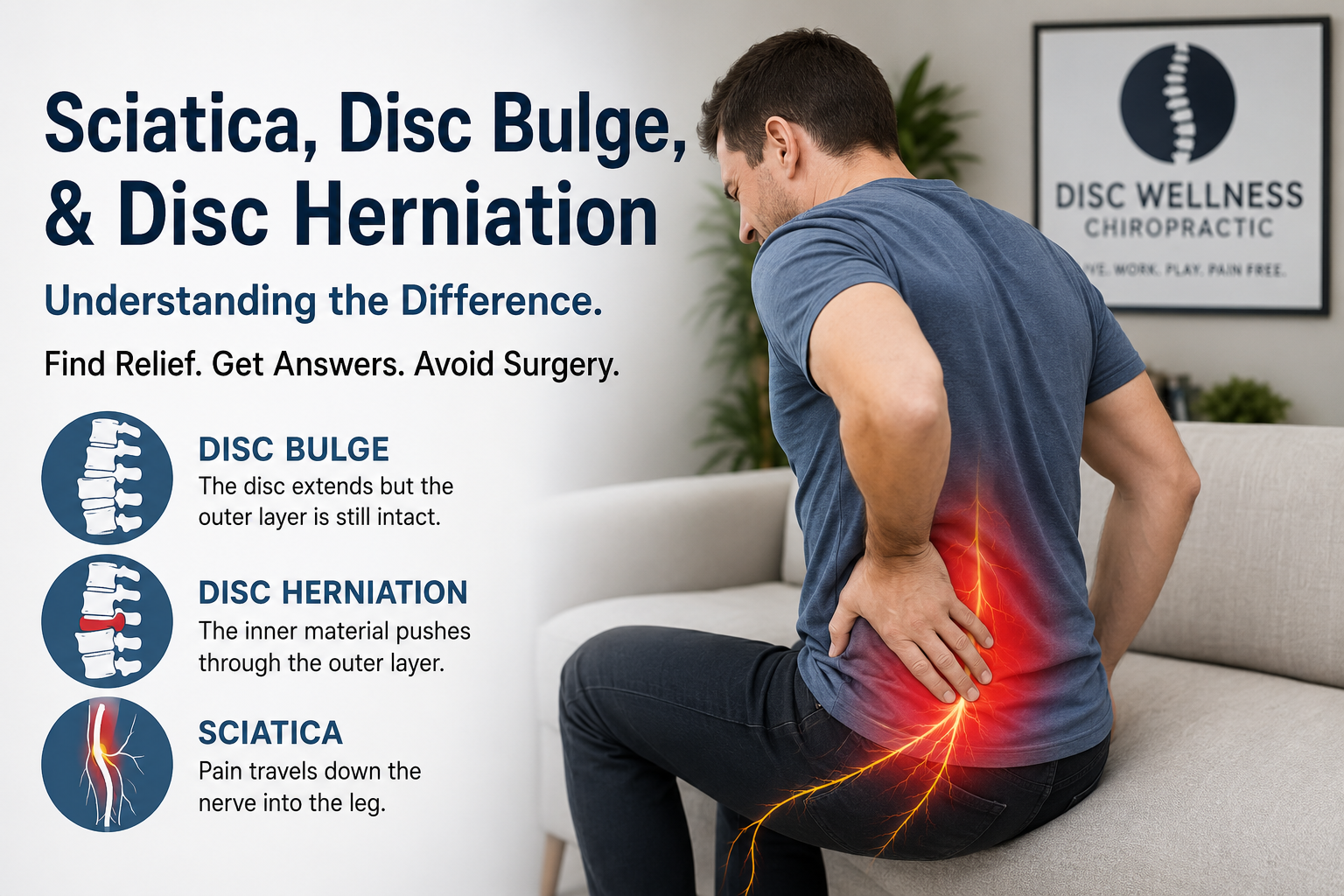
Sciatica is actually a symptom that occurs when the sciatic nerve becomes irritated or compressed.
The sciatic nerve is the largest nerve in the body. It begins in the lower spine, travels through the buttocks, and extends down each leg.
When this nerve becomes irritated, symptoms can develop anywhere along its pathway.
Common symptoms include:
- Pain traveling down the leg
- Burning sensations
- Tingling
- Numbness
- Weakness
- Calf pain
- Foot pain
- Difficulty sitting
- Difficulty standing
- Difficulty walking
- Pain while driving
- Pain when bending forward
Some people describe the sensation as an electric shock. Others describe a deep ache. Some feel burning while others experience numbness.
The important thing to understand is that sciatica is usually caused by something else.
One of the most common causes is a disc problem.
Understanding the Discs in Your Spine
Between each vertebra sits a spinal disc.
Think of a disc like a shock absorber.
These discs help the spine:
- Absorb impact
- Allow movement
- Support flexibility
- Distribute weight
- Protect nearby nerves
A healthy disc allows the spine to move comfortably while protecting important structures.
When a disc becomes injured, nearby nerves may become irritated.
This is where disc bulges and disc herniations come into the picture.
What Is a Disc Bulge?
A disc bulge occurs when a spinal disc begins extending beyond its normal boundaries.
A simple way to think about it is a jelly-filled donut being squeezed.
The donut changes shape, but the outer layer remains intact.
That’s similar to a disc bulge.
The disc extends outward but has not completely broken through its outer layer.
Many people have disc bulges without any symptoms.
The problem occurs when the bulge begins pressing against a nearby nerve.
When that happens, symptoms such as sciatica may develop.
Depending on the location of the bulge, symptoms can travel into:
- The buttock
- The thigh
- The calf
- The foot
- The toes
This is why two people with disc bulges may have completely different experiences.
One person may have mild symptoms while another may struggle to walk comfortably.
What Is a Disc Herniation?
A disc herniation is generally considered a more advanced disc injury.
Using the jelly donut example again, imagine the outer layer developing a tear.
The inner material now begins pushing through the weakened area.
That’s similar to a disc herniation.
The material from inside the disc may irritate nearby nerves, resulting in symptoms that can become more severe.
Common symptoms associated with disc herniations include:
- Sharp shooting pain
- Severe sciatica
- Numbness
- Tingling
- Weakness
- Difficulty sitting
- Difficulty driving
- Difficulty working
- Difficulty sleeping
One challenge with disc herniations is that symptoms vary significantly from person to person.
Some patients experience severe pain.
Others experience numbness with very little pain.
Others notice weakness before they experience significant discomfort.
This is one reason why a thorough evaluation is so important.
Why Does Sciatica Get Worse?
One of the biggest mistakes we see is waiting too long.
Many patients assume that if they simply rest long enough, the problem will disappear.
Sometimes symptoms improve temporarily.
However, many people notice a cycle.
The pain gets better.
They return to normal activities.
The pain comes back.
Then it comes back worse.
This often happens because the underlying issue has never been addressed.
Instead, the symptoms were simply masked.
Over time, continued irritation may create:
- Increased inflammation
- More nerve irritation
- Muscle weakness
- Reduced mobility
- Greater difficulty performing daily activities
This is why early evaluation is so important.
Common Signs You Should Not Ignore
If you’re experiencing any of the following symptoms, it may be time to seek professional evaluation:
- Pain shooting down the leg
- Persistent numbness
- Tingling sensations
- Leg weakness
- Difficulty walking
- Difficulty standing
- Symptoms lasting several weeks
- Symptoms becoming progressively worse
- Pain interfering with sleep
- Pain interfering with work
Many patients tell us they wish they had addressed the problem sooner.
Is Surgery Always Necessary?
Not necessarily.
This is one of the most common fears we hear.
Many patients come to our office after being told that surgery may be necessary.
While surgery is absolutely appropriate in certain situations, many patients have never explored conservative treatment options before considering invasive procedures.
The key is understanding what is actually causing the symptoms.
Without proper evaluation, it’s difficult to determine the most appropriate path forward.
At Disc Wellness Chiropractic, our goal is not to tell every patient they can avoid surgery.
Our goal is to help patients understand their condition and determine whether conservative care may be appropriate for their situation.
The Disc Wellness Protocol
Because so many patients were coming into our office with disc-related conditions, we developed the Disc Wellness Protocol.
The Disc Wellness Protocol was designed specifically for patients experiencing:
- Sciatica
- Disc bulges
- Disc herniations
- Nerve pain
- Pain down the leg
- Numbness
- Tingling
- Chronic low back pain
Rather than relying on a single treatment approach, the protocol combines multiple services based on each patient’s needs.
Depending on the individual case, care may include:
- Specific Gonstead chiropractic adjustments
- Spinal decompression
- Corrective exercises
- Shockwave therapy
- Massage therapy
- Home care recommendations
- Lifestyle guidance
- Movement education
The goal is to address the underlying mechanical stress contributing to the condition while helping patients improve function and quality of life.
Why We Use Gonstead Chiropractic Adjustments
One of the biggest things that separates Disc Wellness Chiropractic is our focus on specific Gonstead chiropractic adjustments.
Rather than applying a generalized approach, Gonstead chiropractic focuses on identifying specific areas of spinal dysfunction.
This allows for precise adjustments designed to improve spinal function and reduce stress on affected areas.
Many patients appreciate that our approach is specific, detailed, and focused on understanding the root cause of their symptoms.
The Role of Spinal Decompression
Spinal decompression is another important component of the Disc Wellness Protocol.
Spinal decompression involves gently stretching the spine in a controlled manner.
The goal is to reduce pressure within the affected spinal segments and support disc health.
Many patients dealing with disc bulges, disc herniations, and sciatica are interested in exploring decompression as part of a comprehensive treatment plan.
Advanced Imaging When Necessary
Sometimes imaging is necessary.
This is why we partner with MRI facilities to help patients obtain advanced imaging when appropriate.
Having access to MRI imaging can provide valuable information regarding:
- Disc bulges
- Disc herniations
- Nerve involvement
- Degenerative changes
- Overall spinal health
This information can help guide clinical decision-making and ensure patients receive appropriate recommendations.
A Real Patient Story
One patient came to our office unable to sit for more than five minutes without severe pain shooting down the leg.
Driving was difficult.
Work was becoming difficult.
Sleep was becoming difficult.
They had tried stretching, resting, and hoping it would improve.
Like many people, they waited too long because they assumed the symptoms would disappear.
After a thorough evaluation and personalized treatment plan, they gradually began noticing improvements in function and daily activities.
While every patient responds differently, stories like this remind us why addressing the problem early can make such a difference.
Why Patients Choose Disc Wellness Chiropractic
Patients throughout Rocklin, Roseville, Lincoln, Granite Bay, and surrounding communities choose our office because they want answers.
They want to understand:
- Why the pain started
- What’s causing the symptoms
- Whether surgery is necessary
- What treatment options are available
- How they can prevent future problems
With over 475 Google reviews, Disc Wellness Chiropractic has become one of the highest-reviewed chiropractic clinics in Placer County.
Our focus is helping patients make informed decisions regarding their health while providing a personalized approach to care.
Serving Rocklin, Roseville, and Lincoln
If you’re searching for a Sciatica Chiropractor in Rocklin, chances are you’re looking for more than temporary relief.
You’re looking for answers.
We proudly serve patients throughout:
- Rocklin
- Roseville
- Lincoln
- Granite Bay
- Loomis
- Wheatland
- Citrus Heights
- Antelope
- Surrounding Placer County communities
Whether you’re dealing with a recent flare-up or symptoms you’ve had for years, understanding the cause is the first step toward finding the right solution.
Conclusion
Sciatica can be frustrating, painful, and life-changing.
Many cases are related to underlying disc issues such as disc bulges and disc herniations.
One of the biggest mistakes people make is waiting too long before seeking answers.
The sooner you understand what’s causing your symptoms, the sooner you can make informed decisions regarding your care.
At Disc Wellness Chiropractic, our Disc Wellness Protocol combines specific Gonstead chiropractic adjustments, spinal decompression, corrective exercises, supportive therapies, and patient education to help individuals dealing with sciatica, disc bulges, and disc herniations.
If you’re experiencing pain, numbness, tingling, or weakness traveling down your leg, don’t ignore it.
Taking action today may help prevent bigger problems tomorrow.
FAQ
Can a disc bulge cause sciatica?
Yes. A disc bulge may irritate or compress nearby nerves, which can result in sciatic symptoms.
Can a disc herniation heal without surgery?
Every case is different. Many patients explore conservative treatment options before considering surgery.
Is sciatica permanent?
Not necessarily. The outcome depends on the underlying cause, severity, and how quickly the condition is addressed.
What is the Disc Wellness Protocol?
The Disc Wellness Protocol is Disc Wellness Chiropractic’s comprehensive approach for patients dealing with sciatica, disc bulges, disc herniations, and nerve-related symptoms.
When should I get an MRI?
MRI imaging may be appropriate when symptoms are severe, persistent, worsening, or when additional diagnostic information is needed.
What areas do you serve?
We serve patients from Rocklin, Roseville, Lincoln, Granite Bay, Loomis, Wheatland, and surrounding Placer County communities.